In our last post, we saw that violent crime on O‘ahu is mostly stable. But crime is also strongly localized and can vary substantially from place to place. Even if crime rates are stable or down island-wide, it can be spiking in one or two areas. (In technical terms, this is called an “ecological fallacy”: we mistakenly think trends for a larger group reflect the trends for subgroups.) Certainly, the news coverage gave that impression, with crime in West O‘ahu, and especially Waianae, repeatedly making the headlines. So, this is an empirical question we can answer: is crime in West O‘ahu and Waianae significantly higher than usual?
Violent Crime in District 8 aka West O‘ahu
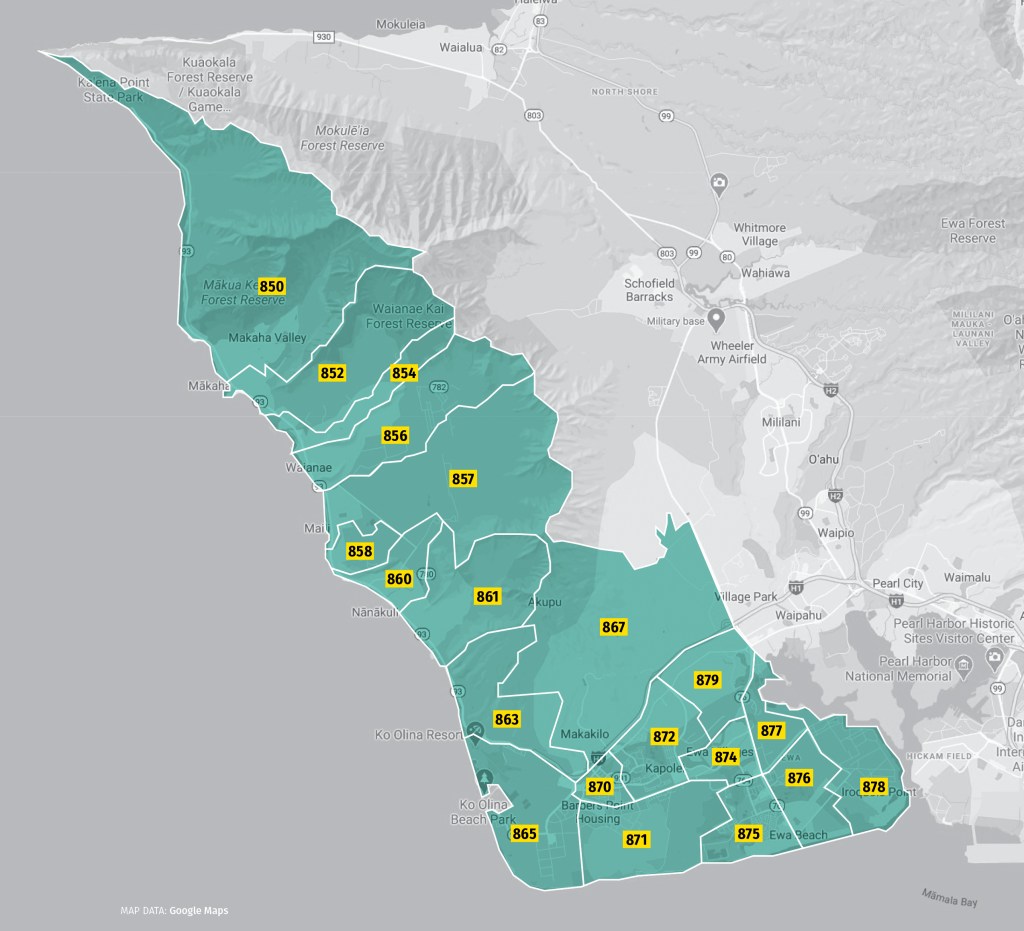
Again, we turn to the HPD’s useful crime dashboard and focus on crime broken down by district. West O‘ahu is covered by the HPD’s District 8, which stretches from Ewa through Kapolei, Ko Olina, Nānākuli, Maili, Waianae, and Mākaha up to Ka‘ena Point. Let’s look at the violent crime count for District 8 using our standard comparison of the last month to the previous month and the last month to the same month the year before.
Aggravated Assault
There were 21 aggravated assaults in August. This is very similar to the number in August 2023 when there were 20. But it is up from the number in July when there were 10.
A jump from 10 to 21 seems big, but I looked at the numbers going back six months and they jump around quite a bit: 16, 25, 18, 16, 13. So 21 is actually within the distribution of what we normally see in the last six months.
Is there reason to panic or celebrate? No, these numbers are within the expected variation.
Murder and Non-Negligent Homicide
There were 5 homicides in August. (If you recall from our last post, there were 5 homicides in the whole island, which means all 5 were in West O‘ahu, indicating some evidence of ecological fallacy.) This is up somewhat from August 2023 when there were 2. It is also up slightly from the number in July when there were 0.
Again, I looked at the prior six months. This time, the 5 homicides is more of a standout. In June, April, and March, there were 0 homicides; in May and February, there were 1 each.
One other issue we run into is especially with homicides, the rate can be somewhat misleading when we have one event with multiple casualties. (In technical terms, they can be “clustered.”) In this case, on August 31, unfortunately, three people were murdered by the same person in one event. We do not have consistent data on events, however, so we cannot compare the number of events over time.
Is there reason to panic or celebrate? While this month’s homicide count was high, and it is certainly understandable to be nervous, there is not yet reason to panic. Importantly, August’s count does not seem to be part of a trend. We should check back next month and see if the count continues to be higher than normal or not.
Robbery
There were 9 robberies in August. This is up slightly from August 2023 when there were 6. It is also up from the number in July when there were 4.
Again, however, looking at the longer trend, we see that the August count was not out of the ordinary: In June and May, there were 13 each, 9 in April, 7 in March, and 6 in February.
Is there reason to panic or celebrate? No, these numbers are within the expected variation.
Sexual Assault
There were 24 sexual assaults in August. This is up from August 2023 when there were 7. It is also up somewhat from the number in July when there were 6.
Looking at the longer trend, we do see that the August count was higher than typical. Between February and June, there were 12, 11, 11, 8, and 13 sexual assaults. Unlike with homicides, we don’t get the same kind of clustering with sexual assaults. That said, the August count is not completely out of the norm, nor is it the highest we’ve seen.
Is there reason to panic or celebrate? As with the homicide numbers, this month’s count was high and it would be understandable to be nervous, but these numbers do not appear to be part of a trend and could simply be unfortunate fluctuation. We will need to check back next month to see.
Violent Crime in Waianae
What about Waianae specifically? If the ecological fallacy holds for the island, can’t it also for the district? Absolutely.
The HPD’s dashboard helpfully breaks down violent crime counts by “beat.” From my read of the map, Waianae covers beats 854 and 856. Unfortunately, we don’t have a breakdown by subcategory of crime, just an overall count of violent crimes. But that still gives us insight!
In August, there were 13 violent crimes in beat 856 and 9 in beat 854. This is up from last August, when there were 5 violent crimes in beat 856 and 3 in beat 854. It is also up substantially from July: there were 0 and 1 crimes in those beats. (In combined numbers, there were 22 violent crimes in the two beats that comprise Waianae; this is up from 8 last August and 1 in July.)
Those numbers are quite high. Since we are just working with this combined category of violent crime, I went back further—through every month this and last year. The numbers do fluctuate quite a bit, ranging from 0 to 6 in beat 856, 0 to 10 in beat 854, and 1 to 13 in the two beats combined. So the numbers from August are quite a bit out of the distribution.
Are they part of a trend? Interestingly, May and June both actually had fairly high violent crime counts, but then things were very quiet in July. So not a continuous trend, but we do see some elevated levels in some recent months—but levels that are closer to the typical distribution.
The other notable feature of the data is the counts in the two beats are not highly correlated. That does make the spike in both beats this August seem to be more significant.
To Conclude
While violent crime is up in all four categories in West O‘ahu, but most notably in homicide and sexual assault, these numbers do not appear to be part of a trend. They may turn out to be very sad statistical fluctuations.
In Waianae specifically, it does look like violent crime was significantly higher in August. This isn’t exactly part of a trend, since July saw only one violent crime—but the somewhat elevated counts in June and July suggest some issues could be brewing. Again, we will have to check back next month to get a better sense of where things are at and where they are going.
 The Hawaii Crime Lab